cap_01
Cluster discovery and registration
Register any PostgreSQL 12+ cluster — managed by ARCloud, hosted bare-metal or running on a vendor cloud — and the platform pulls metrics, version, replication topology and size into one view.
PostgreSQL fleet console
Centralised monitoring, alerting and SQL editor across PostgreSQL clusters. Per-instance and cluster-level RBAC.
PostgreSQL is the backbone of regulated estates — and yet most teams operate their fleet through a patchwork of pgAdmin tabs, ad-hoc psql sessions, Slack-shared SQL files and a couple of scripts that page someone at 03:00. ARStudio replaces that patchwork with a single fleet console: cluster discovery, alert rules, an embedded SQL editor, and per-instance RBAC — all on top of your own PostgreSQL, with the same identity model as the rest of the platform.
Register any PostgreSQL 12+ cluster — managed by ARCloud, hosted bare-metal or running on a vendor cloud — and the platform pulls metrics, version, replication topology and size into one view.
Connections, transactions, replication lag, cache hit rate, bloat. Push-based pipeline, WebSocket streaming to the console. The same data alert rules trigger on.
Rule-based alerting per cluster, per instance or per role. Email notifications by default; webhook output is on the roadmap. Every alert carries operator, timestamp and the offending metric.
CodeMirror-based SQL surface with syntax highlighting and result tables. Queries are tied to your ARStudio identity — every execution lands in the audit log.
Operators see only the clusters they own. DBAs get edit rights on configuration; analysts get read-only SQL. Same identity model used by ARCloud, ARStreams and ARFlow.
Postgres parameters are tracked over time. Drift surfaces immediately — operators see what changed, when, and by whom.
No agent per instance. ARStudio observes from outside through the standard PostgreSQL surface. Adding a cluster takes one registration; removing one takes one click.
Captured from a live evaluation environment. Same UI customers run; nothing reproduced from a brochure.
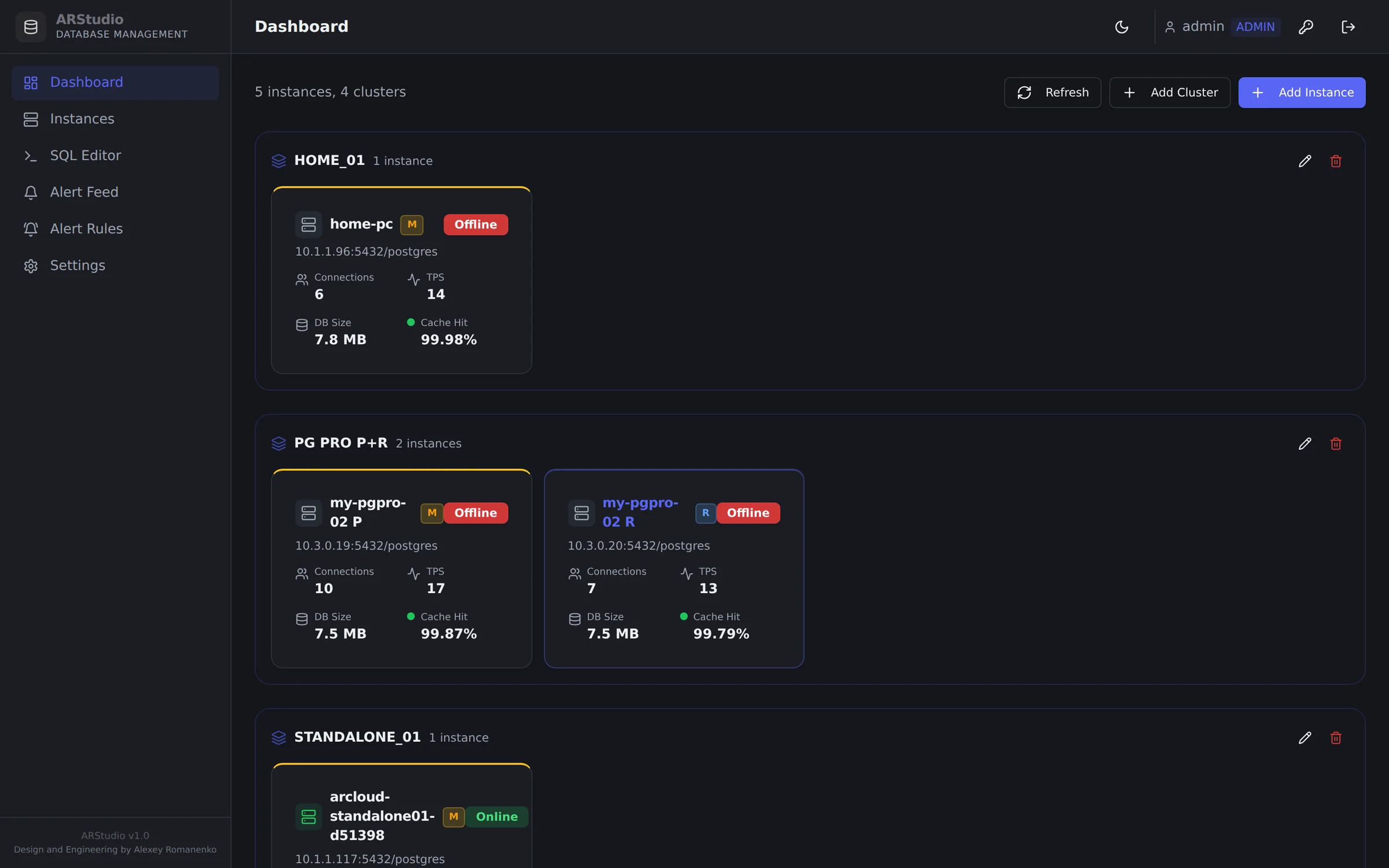
PostgreSQL instances grouped by cluster — connections, TPS, cache hit, online/offline state per instance.
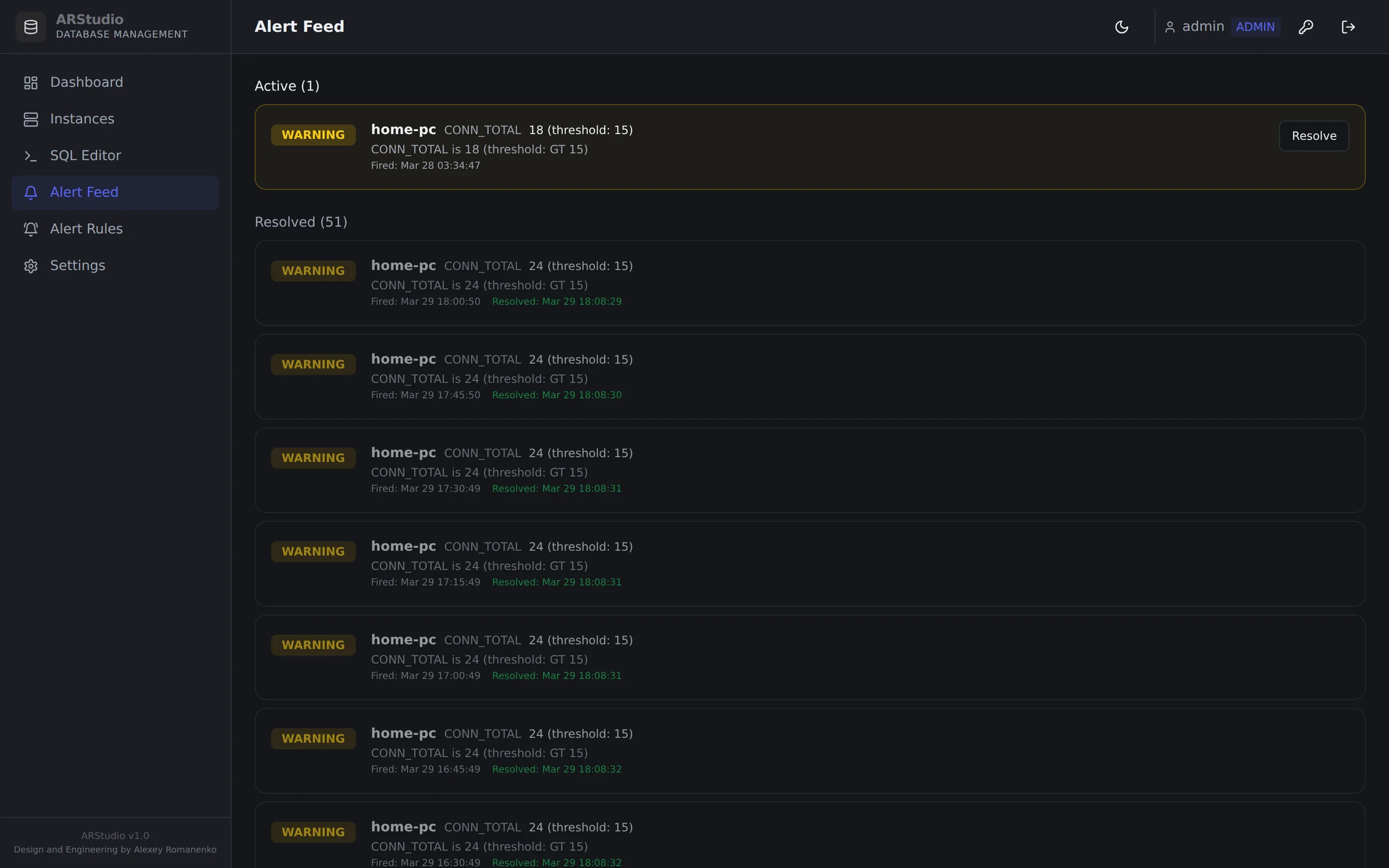
Live alert feed — replication lag, connection saturation and disk pressure surfaced before they page anyone.
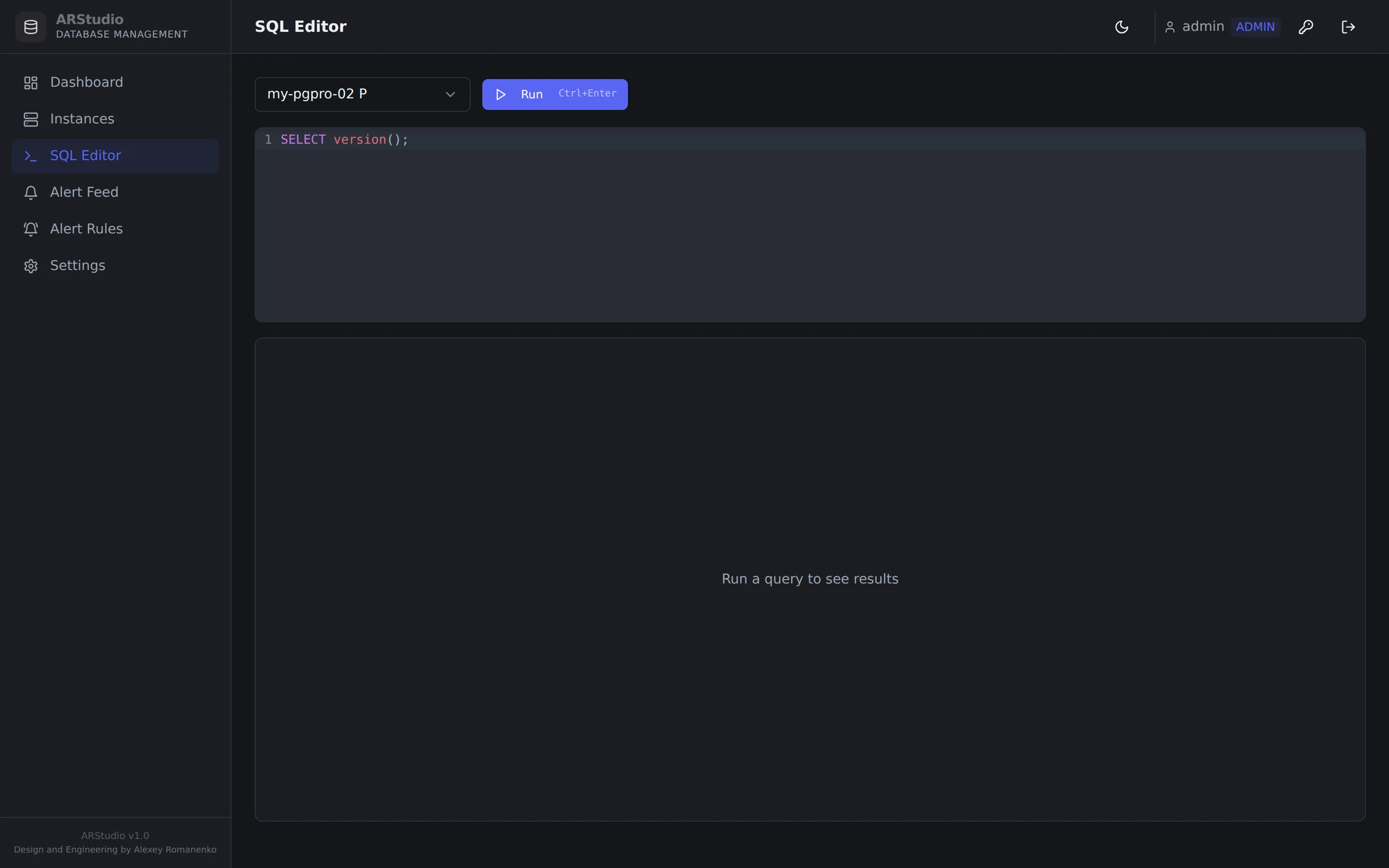
Embedded SQL editor — ad-hoc queries against any registered cluster; credentials never leave ARStudio.
ARStudio is a Spring Boot service with a React + CodeMirror frontend, JWT-secured REST and WebSocket APIs, and its own PostgreSQL for metadata. It connects out to the clusters it observes — there is no agent installed on the database hosts. Spring Mail handles email notifications; nothing else is wired to external services by default.
All metrics and configuration come from the standard PostgreSQL surface (catalog views, pg_stat_*). No probes on database hosts.
Cluster registrations, alert rules, notification history and audit live in the ARStudio metadata database — kept separate from the databases it monitors.
STOMP-over-WebSocket pushes metrics and run state to the React console. Same protocol as ARCloud and ARStreams.
CodeMirror with PostgreSQL grammar. Queries dispatched server-side under the operator’s identity; results paged back through the same channel.
Identity tokens issued by ARStudio carry cluster and role bindings. Every API call resolves against those bindings before touching a connection.
SMTP-only by default. Webhook output is on the roadmap; both will share the same notification pipeline.
Every product action available in the UI is reachable through a JWT-secured REST API. The control plane is the API; the UI is one of its consumers.
Adds a PostgreSQL cluster to ARStudio. Connection string and read-only credentials only.
/api/v1/clusters{
"id": "cluster_billing_prod",
"state": "registered",
"primary": "pg-billing-01",
"replicas": ["pg-billing-02", "pg-billing-03"]
}Live alerts grouped by cluster, with rule, severity and first-seen timestamp.
/api/v1/alerts?state=active[
{
"cluster": "cluster_billing_prod",
"rule": "replication_lag_high",
"severity": "warn",
"since": "2026-05-17T07:42:19Z"
}
]WAL position, lag, connections, query duration buckets — same surface as the dashboard.
/api/v1/clusters/{id}/healthThe `arctl` CLI talks to the same control plane as the UI. Same primitives, scriptable, suitable for CI and on-call.
One command, declarative; safe to commit a registry of clusters to git.
arctl studio cluster register -f clusters/billing-prod.yamlFilterable by severity and cluster. Same surface as the alerts page.
arctl studio alerts list --state=active --severity=warn,criticalCLUSTER RULE SEVERITY SINCE
cluster_billing_prod replication_lag_high warn 4m
cluster_orders_prod connections_near_max warn 18mOperator-grade ad-hoc queries against a registered cluster — credentials stay in ARStudio.
arctl studio sql run --cluster=cluster_billing_prod --snippet=slow-queriesAny cluster reachable on its standard port. Logical replication topology, streaming replication, vanilla Postgres — all supported through catalog introspection.
Managed PostgreSQL clusters provisioned through ARCloud appear in ARStudio automatically once the tenant grants visibility.
Streams running through ARStreams expose their LSN and lag in ARStudio dashboards — replication health visible alongside the source cluster metrics.
ETL runs scheduled through ARFlow surface their source/target connection counts and write throughput in ARStudio. Same identity gates the view.
Email notifications via Spring Mail. Plug in your enterprise SMTP — TLS, auth, sender impersonation all supported.
JWT today; SAML / OIDC federation is the planned next step. The cluster/role binding model already aligns with external IdP claims.
Tens of clusters across regions watched from one console. Alert rules differentiate production / staging / DR; audit captures every config change for the regulator.
A central DBA team operates sovereign PostgreSQL estates for multiple ministries. Cluster-level RBAC keeps tenants apart while one team enforces policy.
During a migration from a commercial DBMS, ARStudio is the single pane on both source and target Postgres clusters — replication lag, configuration drift, capacity headroom.
Analysts run SQL against read replicas through the audited editor instead of via personal psql sessions. The audit log answers the "who ran what" question for compliance.
Configuration audit catches accidental drift between staging and production. Alert rules fire on deviation, not just on outage.
ARStudio ships as a Spring Boot JAR with a React control surface. Runs on a single VM or container. The metadata PostgreSQL is small and lives on the same host or alongside it. The platform only needs outbound TCP to the clusters it observes.
Open the workspace if you already hold credentials, or request guided access through the briefing flow.